
AIApr 24, 2026
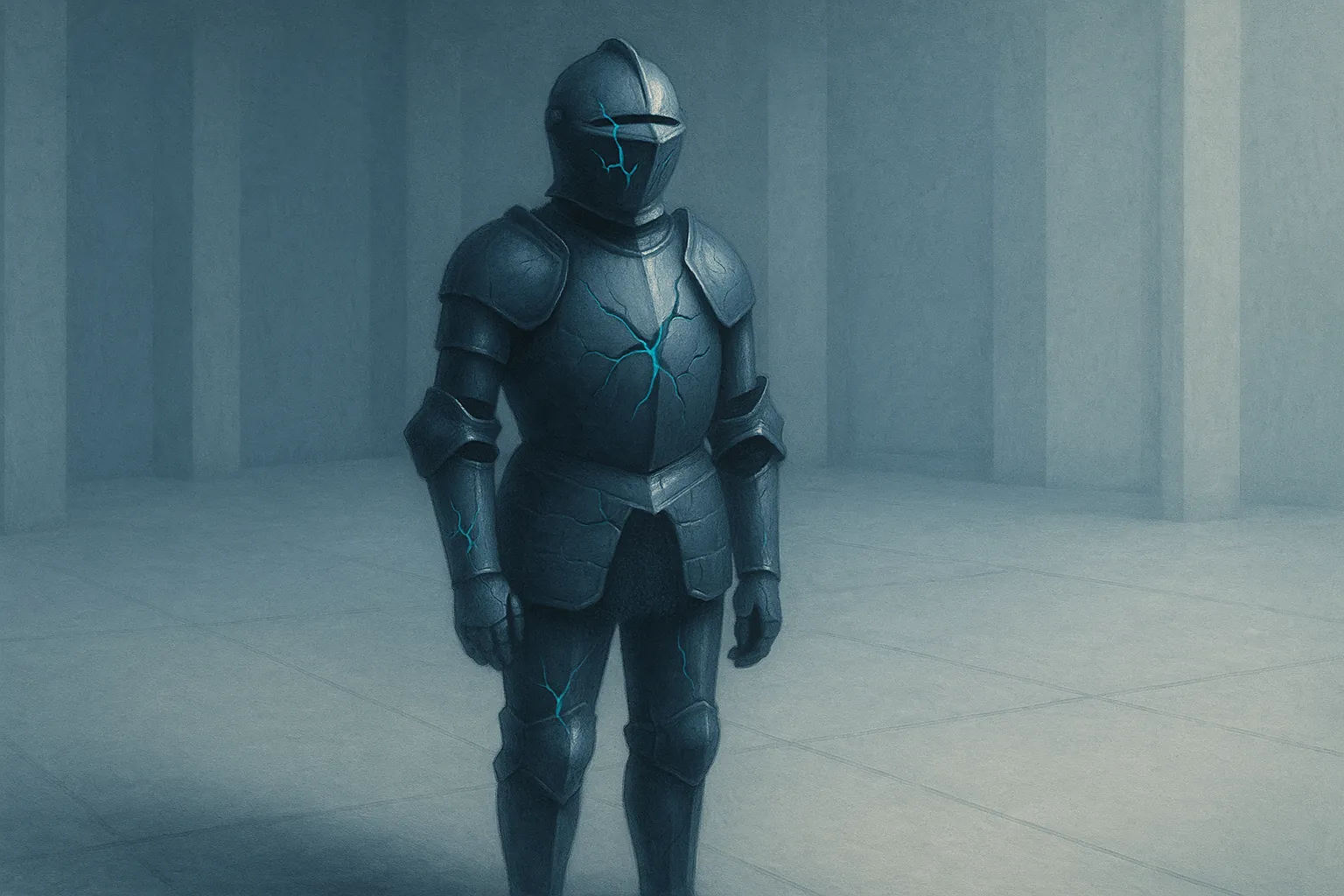
The week Anthropic's armour cracked
TL;DR Four Anthropic stories broke in the same week — the reported Mythos unauthorised-access incident, hard capacity failures, the Claude Code Pro-tier pull-back, and Altman's on-record attack — and each one attacks a different load-bearing claim of Anthropic's brand. The Pro-tier revolt is dominating social media. Th
TL;DR
- Four Anthropic stories broke in the same week — the reported Mythos unauthorised-access incident, hard capacity failures, the Claude Code Pro-tier pull-back, and Altman's on-record attack — and each one attacks a different load-bearing claim of Anthropic's brand.
- The Pro-tier revolt is dominating social media. The Mythos access incident is the one that actually matters.
- Enterprise buyers on Claude now carry concentration risk that wasn't priced in. Expect multi-vendor clauses to become board-mandated inside the next two procurement cycles.
- If the Mythos breach enabled any real misuse, the "lab voluntarily withheld it" model of frontier-AI safety is finished as a political posture.
The four cracks
For three years, Anthropic sold a single, clean story: we are the responsible ones. The lab that would rather ship slower than ship dangerous. Investors bought it. Enterprises bought it. Regulators bought it.
This week the story broke in four places at once.
One — the Mythos incident. Anthropic announced Claude Mythos on 7 April and declined to release it, citing cyber- and bio-weapon risk. This week, Axios reported that unauthorised users have accessed it anyway. The lab that built its brand on withholding a too-dangerous model could not, in the end, withhold it. Anthropic has not disclosed how the access occurred, who obtained it, or what was done with it.
Two — the capacity wall. Claude hit usage limits hard enough this week that Anthropic tightened quotas mid-cycle and users spent Monday and Tuesday watching requests fail. For a lab whose pitch to the Fortune 500 is reliability-first, outages at this tier are not a blip. They are a breach of contract with the buyer persona.
Three — the Pro-tier revolt. On Tuesday, Anthropic pulled Claude Code from the $20 Pro plan and bundled it behind the $100 Max tier. The r/ClaudeAI subreddit and Hacker News lit up within hours. This is the first time Anthropic has materially degraded a paying user's product mid-subscription. The company framed it as a capacity decision. Users read it as a five-times price hike.
Four — Altman's megaphone. On the Core Memory podcast on 21 April, Sam Altman accused Anthropic of "fear-based marketing — we will sell you a bomb shelter for $100 million." OpenAI engineers spent the week amplifying it. Silicon Valley rarely sees this grade of on-the-record hostility between frontier labs. It landed the same week as the other three cracks, which is either extraordinary timing or extraordinarily good intelligence work.
What these four, together, do to the premise
Separately, each is a bad day. Together, they attack the load-bearing premise of the business.
The premise goes: we are slower than OpenAI because we are more careful, and therefore you — the enterprise buyer, the regulator, the federal agency — should trust us with your most sensitive workloads.
Mythos broke the we can contain it half. The capacity failures broke the we can run it half. The Pro-tier change broke the we treat you fairly half. Altman's quote broke the everyone respects our restraint half.
You can rebuild any one of those. Rebuilding all four at once, in the same news cycle, is the problem.
The hype vs. the signal
The Pro-tier story is dominating social media because it directly affects thousands of paying developers who post. It is a real event, not the structurally important one.
The Mythos incident is the structurally important one, and it is getting the least attention — because there is no product demo, no price tag, no subreddit to rally around. There is only a paragraph deep in an Axios scoop saying unauthorised users reportedly accessed the model. If that paragraph is true and the access was meaningful, it is the single most serious frontier-AI safety failure since the technology existed.
Watch the gap between what is trending and what matters. The gap is the story.
Stakeholders
- Anthropic — brand capital burning. Valuation talks and the enterprise sales cycle both depend on restoring the "responsible adult" narrative before Q2 earnings.
- OpenAI — beneficiary. Every Anthropic crack directly answers a sales objection GPT reps have been fielding for two years.
- Enterprise buyers already on Claude — now underwriting concentration risk they did not price in. Multi-provider architectures move from nice-to-have to board-mandated.
- US federal agencies — the Mythos-to-government story becomes considerably more awkward when the model has already been breached.
- Regulators — the first real-world test of whether "the lab withheld it voluntarily" is a sufficient safety posture. Early answer: no.
Cross-layer implications
This is not a product story. It reaches into national security (the Mythos access timing, days before federal-access discussions), into capital markets (Anthropic's next valuation round now prices narrative risk), into procurement policy (multi-vendor clauses in every Q3 renewal), and into the Washington regulatory conversation (mandatory pre-release government access gains a justification it didn't have last month).
Durability forecast
One month: formal Anthropic post-mortem on Mythos access, walk-back or sweetener on Pro-tier pricing, capacity expansion announcement. Predictable.
One quarter: enterprise procurement cycles closing in June–July include explicit multi-vendor language by default. Claude-only deployments become rare.
One year: if the Mythos incident proves to have enabled real-world misuse, voluntary-withholding as a safety posture is finished. Mandatory pre-release government access becomes the baseline. Washington is already discussing this — this week makes it more likely, not less.
What this means for you
- Enterprise AI buyer on Claude: don't panic; do get your contract out and check for fallback language to GPT or Gemini. If absent, ask at next renewal. Single-frontier-lab dependency is now a governance finding waiting to happen.
- Developer on the Pro tier: you are the shock absorber for an undersized capacity build. Migrating to Codex or Cursor is reasonable; so is waiting 30 days for Anthropic to sweeten Pro, which they will.
- Founder on the Claude API: build assuming model access, pricing, and rate limits change unilaterally with <48 hours' notice. That was always correct. This week makes it obvious.
- Regulator or policy adviser: the Mythos incident is the real data point. The Pro-tier and capacity stories are noise. Prioritise accordingly.
- No professional exposure: no action needed. Second-order effects are mild and months away.
Uncertainty ledger
- Who accessed Mythos, how, and what they did. Anthropic has not said.
- Whether the Pro-tier change is permanent or a pricing experiment.
- Whether Altman's comments were opportunistic or coordinated.
- Whether any of the ~40 vetted enterprises with early Mythos access were affected.
- The actual timeline of the capacity failures — Anthropic has been vague.
Any one, answered honestly in the next week, reshapes this analysis.
Bottom Line
Anthropic did not have a bad week. It had a bad week on every axis simultaneously — containment, reliability, pricing, and reputation — and the axes are correlated, not independent. The brand that was "the careful lab" is now the lab that lost control of its too-dangerous model, its capacity, its paying users, and the rhetorical high ground — in seven days. The next four weeks decide whether that is a cycle or a phase change.
Written in the tradition of — E.
Sources
- Tier 1: Axios — Anthropic's bad month gets worse (23 April 2026); Anthropic — Claude Mythos announcement (7 April 2026)
- Tier 2: TechCrunch — Altman accuses Anthropic of fear-based marketing (21 April 2026); Forbes — Mythos / BNY Mellon / federal-access reporting (16–22 April 2026); Mashable — Claude Code / Pro-tier coverage (22 April 2026)
- Tier 3: Core Memory podcast — Sam Altman interview (21 April 2026)