
WorldJun 27, 2026
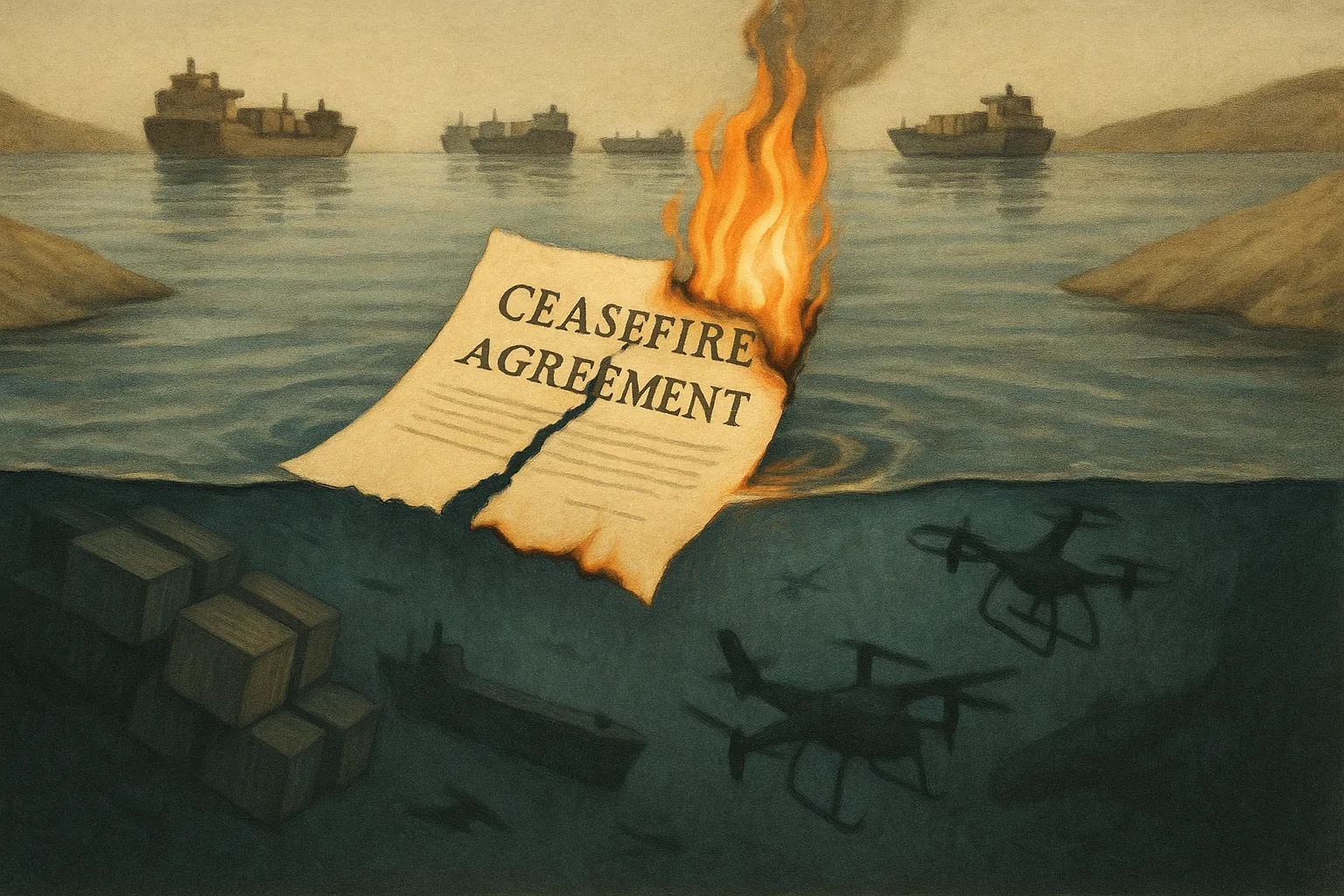
A Ceasefire That Isn't: The Strait of Hormuz Drifts Toward Open Conflict
US strikes on Iranian military facilities mark the collapse of a fragile ceasefire, but the real story is how little either side controls the escalation spiral — and how much the world is betting on calm that nobody has guaranteed.
TL;DR
- The US struck Iranian missile and drone storage facilities and coastal radar positions after a drone attack damaged a cargo ship in the Strait of Hormuz, with President Trump calling it a 'foolish violation' of the ceasefire agreement [1][2][3].
- Iran rejected a UN-backed plan to evacuate trapped commercial ships through the strait, and the International Maritime Organization paused evacuations pending safety guarantees — leaving free passage in limbo [4][6].
- Oil prices fell back to pre-war levels as traffic showed signs of gradually resuming, but that calm rests on no confirmed security arrangement [7].
- Trump asked Congress for billions for the Iran war effort, while Republican operative Karl Rove warned the president's broader Iran approach — including a reported US$300 billion (about A$460 billion) reconstruction fund — may look weaker than Barack Obama's 2015 deal [8][9][10].
- The picture is one of escalation without a framework: strikes, rejections, paused evacuations, and a funding fight in Washington all point to a ceasefire that exists on paper but not on the water.
What happened
On 26 June 2026, US Central Command announced it had struck Iranian military targets — specifically missile and drone storage facilities and coastal radar positions — in response to a drone attack the previous day on a cargo vessel transiting the Strait of Hormuz [1][2]. The drone strike damaged the ship's upper deck, and US forces shot down three additional drones that were aimed at the same vessel [3]. President Trump publicly blamed Iran for the attack and characterised it as a 'foolish violation' of the ceasefire agreement between the two countries [3][5].
The strikes did not emerge from a vacuum. A day earlier, on 25 June, Iran rejected a UN-backed plan for the mass evacuation of ships trapped in the strait, a proposal supported by Oman that was intended to ease a growing maritime bottleneck in one of the world's most critical shipping chokepoints [4]. Iran's rejection signalled what the Guardian's Patrick Wintour and William Christou described as a new threat to free passage through the strait — a waterway vital to the global economy [4]. Shortly after, the International Maritime Organization, a UN agency, paused the evacuation of ships through the strait after the British military reported a vessel had been hit by a projectile off the coast [6]. The IMO said safety guarantees must be confirmed before ships could move again [6].
Meanwhile, market signals were mixed. The BBC reported that oil prices fell back to pre-Iran war levels as signs emerged that traffic through the strait was gradually resuming [7]. At the same time, Trump asked Congress for billions in funding for the Iran war effort, a request that faces an uphill battle as the president spars with members of his own party over the issue [8]. Veteran Republican strategist Karl Rove, writing in The Wall Street Journal, warned that Trump's broader Iran policy — including a reported US$300 billion (about A$460 billion) reconstruction fund and a drawdown of America's regional military presence — may be perceived as weaker than Barack Obama's 2015 nuclear deal with Tehran [9][10].
What it actually means
The core of this story is not the strikes themselves — limited retaliatory strikes against military infrastructure are, tragically, a familiar feature of US-Iran escalation cycles. What is genuinely significant is the simultaneous collapse of every mechanism designed to keep the Strait of Hormuz open and the conflict contained. The ceasefire agreement, which Trump invoked by calling the drone attack a violation, is not being enforced by any visible third party. The UN-backed evacuation plan, supported by Oman, was rejected by Iran outright [4]. The IMO has paused its own evacuation efforts because it cannot confirm safety guarantees [6]. There is, in other words, no functioning de-escalation architecture — only a series of ad hoc responses to the latest incident.
This matters enormously because the Strait of Hormuz is not a peripheral waterway. Roughly a fifth of global oil consumption passes through it on any given day. When the IMO pauses evacuations, when Iran rejects a compromise brokered by Oman, and when the US responds with military strikes, the message to shipping insurers, cargo owners, and energy markets is that nobody is in charge of the chokepoint. The fact that oil prices fell suggests markets are pricing in a quick resumption of traffic [7], but that optimism is not grounded in any confirmed security arrangement — it is a bet that the latest spike will follow the pattern of previous ones. That bet could be upended by a single additional drone strike.
The political dimension in Washington is equally revealing. Trump's request for billions in war funding [8] signals that the administration itself does not view the conflict as winding down, even as oil markets calm. And Karl Rove's warning — carried by both Yahoo and Mediaite, drawing on his Wall Street Journal column — is not a fringe critique. Rove is a pillar of the Republican establishment, and his argument that Trump's Iran approach, including the US$300 billion (about A$460 billion) reconstruction fund and regional drawdown, looks weaker than Obama's deal is designed to resonate with Republican hawks who already distrust the ceasefire framework [9][10]. The fact that Trump is sparring with members of his own party over war funding [8] means the domestic political coalition behind the ceasefire is fracturing at precisely the moment when its military viability is being tested on the water.
Hype deconstruction
It is tempting to read this as the opening salvo of a full-scale US-Iran war, and some coverage leans into that framing. But the evidence does not support it. The US strikes targeted specific military infrastructure — storage facilities and radar positions — not Iranian leadership, nuclear sites, or major population centres [1][2]. This is consistent with a calibrated retaliatory pattern, not a shift to decisive force. Trump's own language, calling the drone attack a 'foolish violation' rather than an act of war, suggests he is still operating within a ceasefire framework, even one he acknowledges is being breached [3][5].
Equally, the oil market's calm should not be mistaken for strategic stability. The BBC's report that prices fell to pre-Iran war levels [7] is a market signal, not a security guarantee. Markets frequently front-run geopolitical de-escalation based on momentum — the assumption that this time will be like last time — only to reverse sharply when the next incident occurs. The IMO's pause on evacuations [6] is the more reliable indicator of actual conditions on the water, and it points to continued danger, not resolution.
Finally, Rove's critique, while politically significant, should not be conflated with an objective assessment of the ceasefire's substance. His argument that Trump's approach is weaker than Obama's deal is a partisan charge aimed at a Republican president from a Republican operative — it is designed to shift policy, not to neutrally evaluate it [9][10]. The US$300 billion (about A$460 billion) reconstruction fund and regional drawdown may well be strategically flawed, but Rove's framing is an argument, not a finding.
Stakeholder landscape
Iran is the actor most actively reshaping the environment. By rejecting the Oman-backed, UN-supported evacuation plan [4], Tehran has signalled that it views control of the strait as leverage, not as a neutral passage to be administered by international bodies. This is consistent with long-standing Iranian doctrine: the strait is a pressure point, and Iran will calibrate disruption to extract concessions. The drone attack on the cargo ship — whether directly ordered by Tehran or carried out by an aligned group — fits this pattern.
The United States is reacting, not dictating. The strikes were retaliatory and narrowly scoped [1][2], and Trump's decision to go to Congress for war funding [8] indicates the administration anticipates a sustained engagement, not a quick exit. But the domestic political coalition is fractured: Rove's public warning [9][10] and reported tensions with Republican members of Congress [8] mean Trump cannot assume unified support even within his own party.
The International Maritime Organization and the broader shipping industry are caught in the middle. The IMO's pause on evacuations [6] is an admission that it cannot guarantee safety — and without that guarantee, commercial shippers and their insurers must make their own risk calculations. The gradual resumption of traffic reported by the BBC [7] suggests some operators are willing to accept the risk, but that calculus could change instantly with another strike.
Oman, which backed the evacuation plan Iran rejected [4], has lost diplomatic ground. Its role as a quiet mediator between Washington and Tehran has been undercut by Iran's refusal, and there is no obvious replacement mediator stepping in.
Oil markets and energy consumers — including Australian households and businesses — are the downstream stakeholders. The price drop [7] offers temporary relief, but it is built on hope, not guarantees.
Cross-layer implications
The most important non-obvious connection here is between the maritime security vacuum in the Strait of Hormuz and the domestic US budget fight. Trump's request for billions in war funding [8] is not just a foreign policy story — it is a fiscal and political one. If Republican dissent hardens, as Rove's column is designed to encourage [9][10], the administration could face a situation where it has committed to military retaliation abroad but cannot secure the funding to sustain it. That would force a choice between escalation without resources and a humiliating walkback — either of which would further erode the credibility of the ceasefire framework.
There is also a shipping insurance feedback loop that deserves attention. The IMO's pause on evacuations [6] means that insurers cannot price risk with confidence. If premiums spike — or if major underwriters withdraw coverage for strait transits entirely — the gradual resumption of traffic the BBC reported [7] could reverse rapidly, regardless of what governments do. Commercial actors, not governments, may end up being the ones who effectively close the strait by refusing to insure passage. This is a layer of the story that military and diplomatic coverage tends to underweight but that could prove decisive.
For Australia specifically, the implications run through energy markets. Australia is a net energy exporter, but global oil price volatility feeds into petrol prices, transport costs, and inflation expectations. A sudden reversal of the current price calm — triggered by another drone strike, an insurance withdrawal, or a Congressional failure to fund the war effort — would be felt at Australian bowsers within weeks.
What this means for you
For most readers, the immediate practical question is energy costs. The current oil price decline [7] is real but fragile. If you are budgeting for fuel, business transport, or any cost sensitive to oil, treat the current calm as a reprieve, not a new baseline. The conditions that produced the spike — a ceasefire nobody enforces, a chokepoint nobody secures, and an evacuation plan nobody accepts — have not been resolved.
If you work in logistics, shipping, or any industry with supply chain exposure to the Persian Gulf, the IMO's pause on evacuations [6] is your operational reality. The gradual resumption of traffic [7] does not mean the route is safe; it means some operators are accepting a risk that the UN's own maritime agency has not certified. Plan for disruption as the default, not the exception.
If you follow US politics, watch the Congressional funding fight [8] and the Republican internal debate catalysed by Rove [9][10]. If Trump cannot secure war funding from his own party, the US escalation ladder shortens dramatically — and that ambiguity will itself be destabilising.
Uncertainty ledger
Several critical claims rest on single sources and would benefit from corroboration. The specific targets of the US strikes — missile and drone storage facilities and coastal radar positions — come from US Central Command via the BBC [1] and have not been independently verified by a second outlet in this bundle. The claim that three additional drones were shot down appears in the Associated Press reporting via the Guardian [3] but is not corroborated elsewhere in the bundle. The US$300 billion (about A$460 billion) reconstruction fund and the regional drawdown are attributed to Karl Rove's Wall Street Journal column as reported by Yahoo and Mediaite [9][10]; the original column itself is not in the bundle, and the figure should be treated as Rove's characterisation until confirmed by an independent source.
The most consequential uncertainty is whether the ceasefire formally exists in any documented form. Trump's reference to a 'foolish violation' of a ceasefire agreement [3][5] implies one is in place, but no source in the bundle provides its terms, its signatories, or its enforcement mechanism. If there is no enforcement mechanism, then violation is a political label, not a legal one — and the ceasefire is whatever the parties say it is on any given day.
The oil market signal [7] is also less certain than it appears. Gradual resumption of traffic could mean anything from a handful of vessels moving under naval escort to a broader normalisation. Without volume data, the market's optimism is hard to evaluate.
What would change the analysis: a second confirmed drone strike on a commercial vessel would shatter the market calm and likely force the IMO to abandon evacuation efforts entirely. A Congressional refusal to fund the war request would constrain US military options and embolden Iran. And an independent verification of the US$300 billion reconstruction fund figure would transform the domestic political debate from speculation into a concrete policy fight.
Bottom line
The US strikes are a symptom, not a turning point. The real story is that every mechanism meant to keep the Strait of Hormuz open — the ceasefire, the UN evacuation plan, the IMO's safety process — has either been violated, rejected, or paused, and nobody has replaced them with anything functional. Markets are calm, but that calm is a bet on inertia, not on security. Until there is a verified enforcement framework for the strait, every lull is just a pause between incidents.
Sources
- bbc.co.uk. (26 June 2026). US conducts strikes on Iran after attack on cargo ship.
- Andrew Roth in Washington. (26 June 2026). US says it struck Iran targets after attack on cargo ship in the strait of Hormuz. theguardian.com.
- Associated Press. (26 June 2026). Trump blames Iran for drone strike on cargo ship in strait of Hormuz. theguardian.com.
- Patrick Wintour and William Christou. (25 June 2026). Iran rejects UN-backed plan to free ships trapped in strait of Hormuz. theguardian.com.
- Robert Mackey (now); Lucy Campbell, Marina Dunbar and Aneesa Ahmed (earlier). (26 June 2026). US military strikes Iran in response to attack on cargo ship, Pentagon says – live. theguardian.com.
- Associated Press. (26 June 2026). UN agency pauses ship evacuations through strait of Hormuz after vessel struck. theguardian.com.
- bbc.co.uk. (25 June 2026). Oil price falls back to pre-Iran war levels.
- bbc.co.uk. (25 June 2026). Trump asks Congress for billions for Iran war, after tension with Republicans.
- Isaac Schorr. (25 June 2026). 'Weaker Than Barack Obama's' Deal: Karl Rove Warns Trump He's Courting 'Political and Foreign Policy Disaster' With Iran MOU. Yahoo.
- Isaac Schorr. (25 June 2026). 'Weaker Than Barack Obama's' Deal: Karl Rove Warns Trump He's Courting 'Political and Foreign Policy Disaster' With Iran MOU. Mediaite.