
GrowthJun 28, 2026
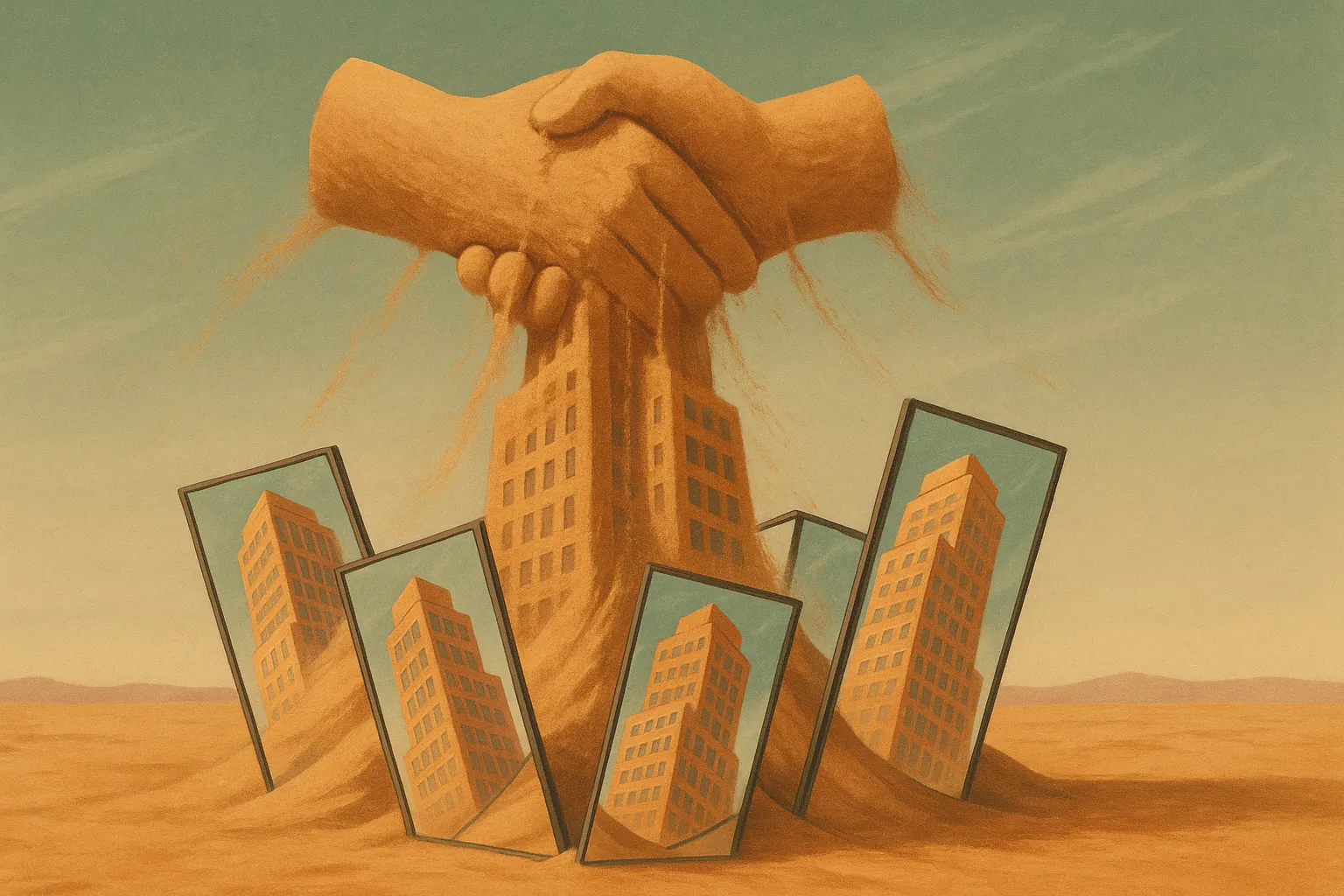
Musk's Mesh Acquisition: A Story Built on Shifting Sand
The FTC clearance exists, but the target company's identity is disputed across sources, making this a cautionary tale about viral financial news.
TL;DR
- The FTC granted early termination of antitrust review for a Musk-linked acquisition, but which company was acquired is actively disputed across the sources covering this story [1][2][3][4].
- Three Tier-2 outlets report the target as Mesh Optical Technologies Corp., a Silicon Valley startup making data center communication chips, founded by former SpaceX engineers [2][3][4].
- One Tier-2 outlet, Crypto Briefing, directly contradicts that narrative, claiming the real FTC clearance was for APR Energy LLC, a Jacksonville-based modular power generation firm — not Mesh at all [1].
- Financial terms have not been disclosed by any party [2][3][4], and no Tier-1 primary source has been cited by any of the four outlets.
- The story is actionable in shape but unverified in substance: readers should treat the Mesh-specific claims as unproven until a primary FTC filing or a statement from Musk or the companies confirms the target.
What happened
On June 25, 2026, the Federal Trade Commission granted early termination of the Hart-Scott-Rodino antitrust waiting period for a transaction listed under transaction number 20261601, with Elon Musk designated as the acquiring party [2][3][4]. Early termination is a routine procedural step: it means regulators have decided not to extend the standard review window, effectively clearing the deal to proceed. It is not a substantive endorsement of a merger's merits, but it does remove a significant regulatory hurdle.
Three of the four sources in the research bundle — Asianet News Network, Yahoo! Finance, and Stocktwits — report that the target company is Mesh Optical Technologies Corp., described as a Silicon Valley startup specializing in data center communication chips and founded by former SpaceX engineers [2][3][4]. These reports frame the acquisition as part of Musk's broader push into hardware infrastructure, coming on the heels of what they describe as SpaceX's historic initial public offering earlier in June 2026 [2][3][4]. The financial terms of the deal have not been disclosed by either party, according to all three outlets [2][3][4].
However, the fourth source — Crypto Briefing — tells a fundamentally different story. It claims the Mesh narrative is false, and that the actual FTC clearance involved APR Energy LLC, a Jacksonville-based firm specializing in modular power generation systems that can be deployed in a month or less [1]. According to Crypto Briefing, the FTC granted early antitrust termination on May 14, 2026 — not June 25 — for the APR Energy acquisition [1]. This source explicitly frames its reporting as a debunking, stating that "the problem: it doesn't appear to be true" regarding the Mesh story [1].
The contradiction is stark. We have two different company names, two different dates, and two different business descriptions — all attributed to the same underlying regulatory event. At least one of these narratives is wrong, and the sources provide no mechanism for reconciling them.
What it actually means
The real story here is not about Musk acquiring a specific company. It is about how quickly a confident-sounding financial news narrative can propagate without primary-source verification. Three outlets published near-identical reports about Mesh Optical Technologies, using the same framing, the same transaction number, and the same biographical detail about SpaceX alumni founders [2][3][4]. Two of them — the Yahoo! Finance and Stocktwits articles — share the same byline, Shashank Nayar [3][4], which means the reporting likely originated from a single desk and was syndicated outward. The Asianet News Network piece is credited to Stocktwits Inc [2], further suggesting a common origin point.
In other words, what looks like three independent confirmations is more likely one report amplified through three channels. That is a critical distinction for any reader trying to assess the reliability of the Mesh narrative. Corroboration requires independent sourcing, not the same story republished under different mastheads.
Crypto Briefing's counter-claim adds another layer of complexity [1]. If its reporting is accurate, then the Mesh story is not merely unverified — it is actively wrong, and the real acquisition target is a power generation company with a completely different profile. APR Energy, as described by Crypto Briefing, builds rapid-deployment modular power systems [1], which would fit Musk's well-documented interest in energy infrastructure (through Tesla Energy and related ventures) but would have nothing to do with optical chips or data center communications.
The problem is that Crypto Briefing's debunking is itself a single-source claim [1]. It provides no link to the primary FTC filing, no statement from APR Energy, and no on-record confirmation from Musk or his representatives. It asserts that the real deal involved APR Energy and a May 14 date, but the evidence base is no stronger than the Mesh narrative it seeks to correct. We are left with two unverified stories, each told by Tier-2 outlets, each lacking primary-source citation, and each flatly contradicting the other.
What this actually means is that the public record on this transaction is a mess. The FTC early termination notice — transaction number 20261601 — apparently exists [2][3][4], but neither side of the reporting has done the basic journalistic work of linking to it or quoting from it. Until someone does, the identity of the acquisition target remains genuinely unknown to the public, despite the confidence of the reporting.
Hype deconstruction
Several elements of this story carry the hallmarks of hype-driven amplification rather than verified reporting.
First, the SpaceX alumni angle [2][3][4] is a narrative convenience, not a verified fact. No source provides the names of the founders, their tenure at SpaceX, or any corroborating detail. The claim that Mesh was "launched by a team of former SpaceX engineers" [2][3][4] is presented without attribution to a company profile, a LinkedIn search, or an interview. It functions as a credibility signal — Musk-adjacent, technically serious — but it has not been checked by any source in the bundle.
Second, the framing of the acquisition as part of an "aggressive push into hardware infrastructure" following "SpaceX's historic initial public offering" [2][3][4] is speculative narrative scaffolding. The SpaceX IPO is mentioned as context, not as a verified event with a date, valuation, or filing. It serves to make the Mesh acquisition sound like part of a larger, coordinated strategy — but strategy is inferred, not reported. No source quotes Musk, a Musk-affiliated entity, or any insider describing strategic intent.
Third, the transaction number itself — 20261601 — is cited as evidence of the FTC's action [2][3][4], but no source links to the actual FTC notice or explains how the number was obtained. A transaction number is checkable: the FTC publishes early termination notices. The absence of a link or a quoted excerpt from the primary document is a red flag, particularly when the entire story turns on what that document says.
Fourth, Crypto Briefing's debunking [1] is itself a form of counter-hype. It frames the Mesh story as a false narrative and presents APR Energy as the real deal, but it does so with the same evidentiary thinness it criticizes. The claim that APR Energy builds systems "installable in one month or less" [1] reads like a company marketing description, not independent reporting. The May 14 date [1] is stated without a link to the FTC filing. The debunking may be correct, but it is not proven — and presenting it as definitive would be making the same error as the outlets it criticizes.
What this story is not: it is not a confirmed acquisition of Mesh Optical Technologies by Elon Musk. It is not a confirmed acquisition of APR Energy by Elon Musk. It is a confirmed FTC early termination notice of unknown target, wrapped in two competing narratives, neither of which has been verified against the primary source.
Stakeholder landscape
The stakeholders in this story fall into several groups, each with different incentives.
Musk and his affiliated entities are the central figure. If the Mesh narrative is correct, the acquisition would extend Musk's reach into data center infrastructure — a space adjacent to his AI ambitions through xAI and his compute-heavy operations. If the APR Energy narrative is correct, the deal would align with his energy interests through Tesla Energy. Either way, Musk benefits from the perception of relentless dealmaking, which reinforces his public image as a serial acquirer and builder. He has not, however, publicly confirmed either version.
Mesh Optical Technologies — if it exists as described — would gain enormous visibility from being named as a Musk acquisition target. For a startup, that kind of attention can attract investors, talent, and partners, regardless of whether the deal closes. But if the Crypto Briefing debunking is correct, Mesh's name is being used in a story that has nothing to do with the company, which could create confusion or reputational complications.
APR Energy LLC, if it is the real target, has been largely invisible in the coverage. Only Crypto Briefing names it [1], and it has not been the subject of the syndicated reporting that pushed the Mesh narrative. If APR Energy is the actual acquisition target, its erasure from the main story is itself a significant failure of the reporting.
The FTC is a passive stakeholder here. Its early termination process is routine, but the confusion around this transaction illustrates how easily regulatory filings can be misidentified or misreported when journalists do not link to primary documents.
Readers and investors are the most affected external group. Anyone who acted on the Mesh narrative — buying shares in a related company, adjusting a portfolio, or simply forming a view about Musk's strategy — may have been acting on unverified information. The absence of financial terms [2][3][4] means there is no deal valuation to assess, and the disputed target identity means there is no company to research.
The reporting outlets themselves have a stake in credibility. The three outlets carrying the Mesh story [2][3][4] have published a confident narrative that may be wrong. Crypto Briefing [1] has published a confident debunking that may also be wrong. The reputational risk for all four is real, and the lack of primary-source citation is a shared failure.
Cross-layer implications
One non-obvious connection worth drawing is between this story and the broader problem of syndicated financial news in the age of AI-generated content. The three Mesh reports [2][3][4] are so similar in structure, language, and detail that they appear to originate from a single source — likely the Stocktwits article by Shashank Nayar [4], which was then republished on Yahoo! Finance [3] and Asianet News Network [2]. This is not unusual in financial journalism, but it has a specific consequence: a single error can be mistaken for multiple confirmations.
For readers, this means that the number of outlets covering a story is a weaker signal of reliability than it appears. Three publishers reporting the same fact is not three independent data points if they are all drawing from the same wire. The research bundle itself flags this: the Signal Score notes "4 publishers covering" as a reach proxy, but also that there are "no corroborated claims yet" — a tension that this story illustrates perfectly. Volume of coverage is not the same as depth of verification.
A second cross-layer implication concerns the FTC's early termination process as a source of market-moving information. These notices are public, but they are terse and procedural — they identify the acquiring party and a transaction number, but they do not always make the target company obvious to a casual reader. If journalists misread or misidentify the target, the resulting story can move sentiment in the wrong direction. This is not a hypothetical risk: it is exactly what appears to have happened here, with two different companies named as the target across four sources [1][2][3][4].
What this means for you
If you are an Australian reader following Musk's business activities or considering investment exposure to companies in his orbit, the practical takeaway is do not act on this story yet. The identity of the acquisition target is disputed, the financial terms are undisclosed [2][3][4], and no primary source has been cited by any outlet in the bundle. There is no company to research, no valuation to assess, and no confirmed strategic rationale to evaluate.
If you encountered the Mesh Optical Technologies narrative on social media or through a financial news aggregator, treat it as unverified. The fact that it appeared on Yahoo! Finance [3] does not make it reliable — the article shares a byline with the Stocktwits piece [4], and both likely draw from the same origin. The Asianet News Network version [2] is credited to Stocktwits Inc, reinforcing the single-source problem.
If you are interested in the factual question of what the FTC actually cleared, the only responsible action is to look up transaction number 20261601 on the FTC's early termination notices. The FTC publishes these. If the notice identifies the target company, that is your answer — and it will be more reliable than any of the four sources in this bundle.
If you are a journalist or analyst, this story is a case study in why primary-source citation matters. Every claim in the bundle — the Mesh identity, the SpaceX alumni founders, the SpaceX IPO, the APR Energy counter-claim, the May 14 date — is single-sourced or syndicated from a single source. None of it has been checked against the primary document. The cost of doing that checking is low; the cost of getting it wrong is high.
Uncertainty ledger
Unresolved: the identity of the acquisition target. Three sources say Mesh Optical Technologies [2][3][4]; one says APR Energy [1]. Neither claim has been verified against the primary FTC filing. This is the central uncertainty and the one that most changes the analysis.
Unresolved: the date of the FTC clearance. Three sources say June 25, 2026 [2][3][4]; one says May 14, 2026 [1]. These are not reconcilable without access to the primary notice. If both dates are real, they may refer to different transactions — which would mean the entire story is a case of mistaken identity between two separate Musk-linked deals.
Unresolved: the existence and profile of Mesh Optical Technologies. No source provides a company website, a registration filing, or named founders. The "SpaceX alumni" detail [2][3][4] is unattributed. It is possible that Mesh exists exactly as described, but it is also possible that the company's profile has been constructed from partial or inaccurate information.
Unresolved: the SpaceX IPO claim. Three sources reference "SpaceX's historic initial public offering earlier this month" [2][3][4] as context, but none provides a date, a filing, or a valuation. If the IPO did not occur or is inaccurately described, the strategic framing of the Mesh acquisition collapses.
Unresolved: financial terms. No source reports a purchase price, share structure, or deal value [2][3][4]. Without this, the financial significance of the acquisition cannot be assessed regardless of which company is the target.
What would change the analysis: A link to or quotation from the primary FTC early termination notice for transaction number 20261601 would resolve the target identity and the date. A statement from Musk, Mesh Optical Technologies, or APR Energy would do the same. Until one of these appears, the story remains in its current state of plausible but unverified.
Bottom line
The FTC early termination notice is real, but everything beyond that — the target company, the date, the strategic rationale — is contested by sources that have not done the basic work of citing the primary document. Three outlets published a confident Mesh narrative that likely originated from a single report, and one outlet published a confident debunking that is no better sourced. This is a story about the failure of verification, not about a confirmed acquisition, and readers should treat every specific claim as unproven until the FTC filing itself is produced.
Sources
- Editorial Team. (26 June 2026). Elon Musk cleared by FTC to acquire startup Mesh? Not quite. Here's what actually happened. Crypto Briefing.
- Stocktwits Inc. (26 June 2026). Elon Musk Secures FTC Clearance to Acquire SpaceX Alumni Startup Mesh Optical Technologies. Asianet News Network Pvt Ltd.
- Shashank Nayar. (26 June 2026). Elon Musk Secures FTC Clearance to Acquire SpaceX Alumni Startup Mesh Optical Technologies. Yahoo! Finance.
- Shashank Nayar. (26 June 2026). Elon Musk Secures FTC Clearance to Acquire SpaceX Alumni Startup Mesh Optical Technologies. Stocktwits.