
ScienceApr 28, 2026
An embryo curled inside a 250-million-year-old egg has settled a debat
TL;DR A team has reported the world's oldest fossilised mammal-ancestor egg, with the embryo still inside, from the Eastern Cape of South Africa (April 2026). The fossil belongs to Lystrosaurus, a therapsid (mammal-like reptile) that survived the Permian–Triassic extinction and dominated terrestrial vertebrate communit
TL;DR
- A team has reported the world's oldest fossilised mammal-ancestor egg, with the embryo still inside, from the Eastern Cape of South Africa (April 2026).
- The fossil belongs to Lystrosaurus, a therapsid (mammal-like reptile) that survived the Permian–Triassic extinction and dominated terrestrial vertebrate communities for several million years afterward.
- The fossil is roughly 250 million years old — placing it just after Earth's largest mass extinction.
- It is the first direct evidence that synapsids (the lineage that became mammals) laid hard-shelled eggs at the base of the mammal evolutionary tree.
What was actually found
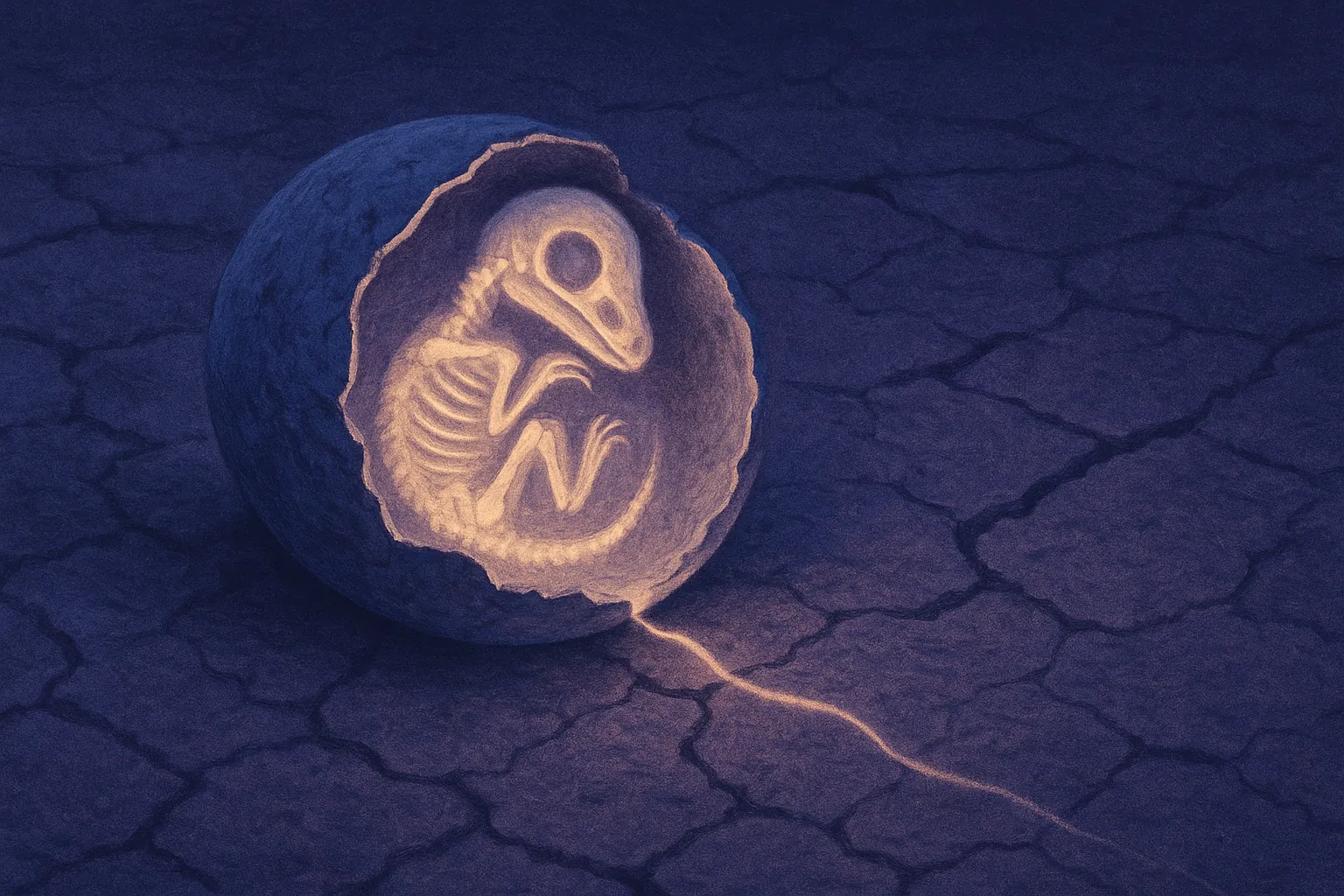
The fossil is a single egg, slightly larger than a chicken egg, with a partially preserved shell and — this is the part that has palaeontologists' attention — a curled embryonic skeleton inside. The skeleton's anatomy identifies it as Lystrosaurus: a stocky, herbivorous therapsid the size of a small pig, one of the few medium-sized vertebrates that came through the end-Permian extinction event.
For decades, Lystrosaurus has been one of the best-known fossil vertebrates of the early Triassic. Tens of thousands of specimens have been recovered. None of them was an egg. None was an embryo.
This one is both.
Why this settles a long argument
The synapsid lineage — the lineage that includes today's mammals and all their pre-mammalian ancestors — diverged from the rest of the amniote tree more than 300 million years ago. By the early Triassic, that lineage had produced therapsids like Lystrosaurus, which would eventually give rise to true mammals 50 million years later.
For more than a century, palaeontologists have asked: did these animals lay eggs, or did they (like marsupials and placentals do today) carry their young live? The answer matters because reproductive mode is one of the foundational characters of an evolutionary lineage. It also matters because the only egg-laying mammals alive today — the platypus and the echidnas — are evolutionary outliers, and the question of whether they retain an ancestral state or evolved egg-laying secondarily has remained genuinely open.
The April fossil resolves the basal condition. Lystrosaurus laid eggs. The synapsid lineage was egg-laying at this evolutionary stage. Live birth in mammals is a derived feature, evolved later, after this branch.
What's actually new
The methodological step is direct fossilisation of egg, shell, and embryo together. Eggs by themselves are extremely rare in the early Triassic record; eggs with embryos are vanishingly rare; eggs with embryos identifiable to a specific therapsid taxon were not previously known.
The find is also exceptional in its timing. The Permian–Triassic boundary is the single largest extinction event in Earth's history — roughly 95% of marine species and about 70% of terrestrial vertebrate genera disappeared. Lystrosaurus is famous as one of the survivors. Recovering an egg with embryo from the immediate post-extinction recovery period gives us an unprecedented window into how reproductive strategy interacted with extinction survival.
What this isn't
Not the oldest egg ever found. Older eggs from non-synapsid amniotes (the lineages that became reptiles and birds) are known.
Not a discovery of mammal-like reproduction. Live birth in mammals evolved much later. The fossil tells us about the synapsid stem-lineage, not the crown mammals.
Not, as some early reporting suggested, an "egg-laying mammal." Lystrosaurus is not a mammal. It is a therapsid, a member of the lineage that became mammals tens of millions of years later.
Stakeholder landscape
- Palaeontologists working on the synapsid lineage — direct beneficiaries; this is the kind of fossil that anchors decades of follow-on work.
- Evolutionary biologists studying reproductive mode — the find tightens phylogenetic inference about when, exactly, in the synapsid lineage live birth evolved.
- South African scientific institutions — the Eastern Cape's Karoo Basin remains the world's most productive site for Permian–Triassic vertebrate fossils. The find reinforces a strategic scientific asset.
- Museum educators — the most visually compelling palaeontological find of the year, easily.
Cross-layer implications
- Extinction biology — survivor traits in mass extinctions are a long-standing research category. Reproductive strategy is one of the candidate traits; this fossil provides hard evidence on what Lystrosaurus's strategy actually was.
- Developmental palaeontology — the field of palaeo-embryology has been waiting for fossils like this. Comparative embryonic anatomy across the synapsid stem is now possible in a way it was not last year.
- Public engagement — the image of an embryo curled inside a 250-million-year-old egg is the kind of artefact that does what museum specimens are meant to do. Expect it on the cover of textbooks within five years.
Uncertainty ledger
- The exact age of the fossil (the precise stage within the early Triassic) will be refined as the locality is studied further.
- Embryonic identification to Lystrosaurus specifically is well supported, but the broader question of whether the egg-laying habit applies uniformly across all therapsids of this period remains to be tested with further finds.
- The condition of the eggshell (hard vs. parchment-like) is being studied; the chemistry of the preserved shell will shape inferences about parental care and nesting behaviour.
Bottom Line
A 19th-century question about how mammals reach the world has been answered, in part, by an embryo curled inside an egg in a rock in South Africa. Lystrosaurus laid eggs. The mammalian capacity for live birth evolved later, after this branch of the family tree. We now have, for the first time, a direct image of how the lineage that became us reproduced 250 million years ago — at the dawn of the Triassic, in the immediate aftermath of the worst extinction Earth has known.
Sources
- Lystrosaurus egg-and-embryo paper, peer-reviewed publication (April 2026) — Tier 1
- Phys.org, Eastern Cape fossil announcement (12 April 2026) — Tier 2
- ScienceDaily, synapsid reproductive evolution feature (April 2026) — Tier 2
- Existing Karoo Basin Permian–Triassic vertebrate literature — Tier 1 (referenced)