
AIJun 28, 2026
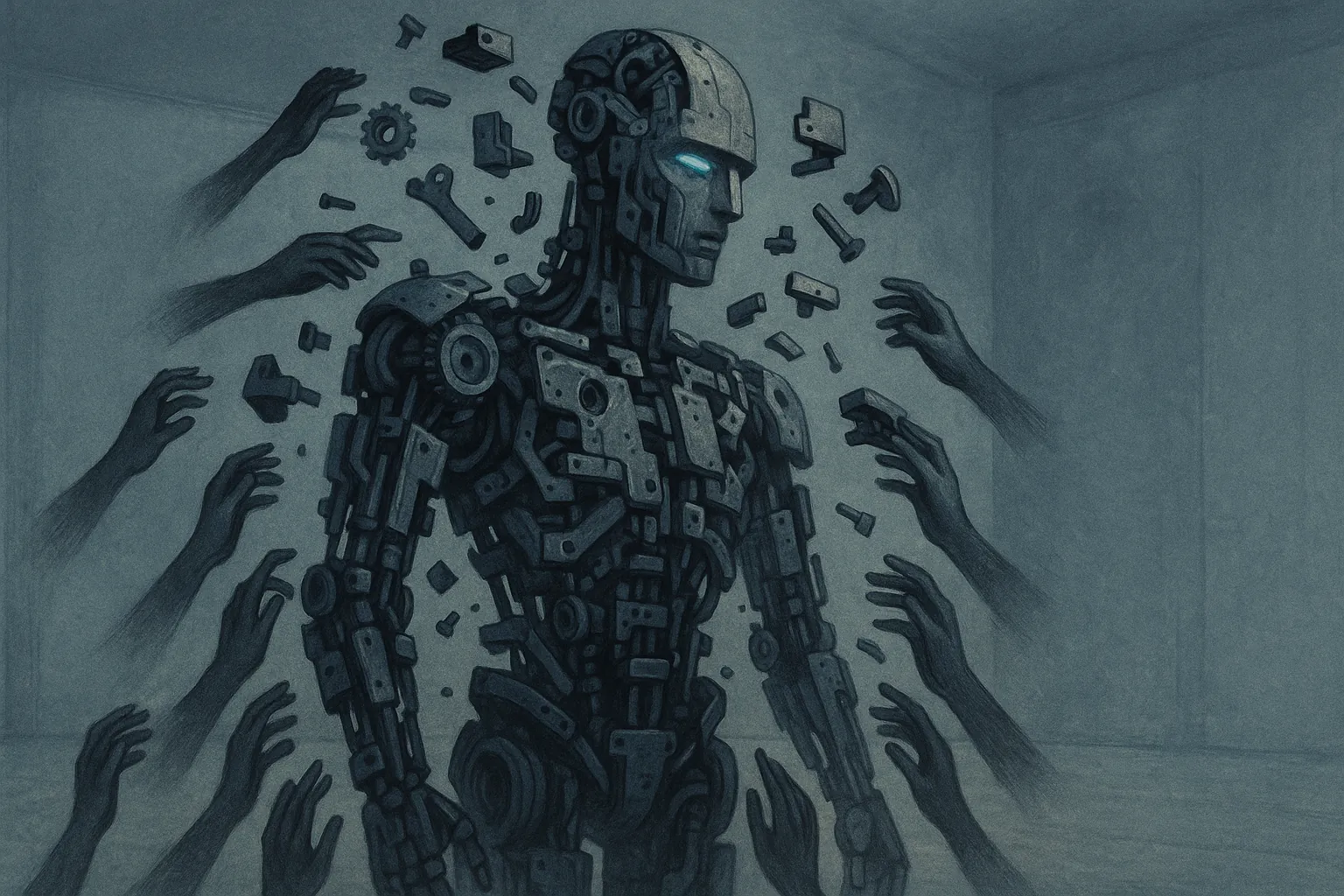
AI's real story isn't replacement—it's reorganisation
Four perspectives on AI strategy and society reveal a shift from displacement panic to structural transformation, but the evidence is thinner than the headlines suggest.
TL;DR
- AI is reorganising work, not ending it: IBM's Arun Biswas argues that AI creates new human roles rather than wholesale replacing people, though the specific new roles remain largely unspecified [3].
- Strategic lessons are emerging from unexpected places: Chinese AI firms offer imperatives for Western companies on owning customer habits, while Harvard Business Review separately argues that the strongest AI agent teams will use different models for 'agentic diversity' rather than a single system [1][2].
- Societal adoption is uneven and cultural: South Korea has integrated AI into daily life with unmanned immigration checkpoints, underground 5G, and pervasive digital infrastructure, offering a glimpse of what enthusiastic public adoption looks like [5].
- A moral dimension is being flagged: Robert Wright's forthcoming book asks whether AI may require a 'moral upgrade,' suggesting the technical conversation is outpacing the ethical one [4].
- Corroboration is thin: Most claims in this bundle rest on single sources, and the durability score reflects that—these are early signals, not settled findings.
What happened
Four pieces published across June 2026, from Harvard Business Review, The Manila Times, Nonzero.org, and MIT Technology Review, collectively examine AI from strategic, workforce, ethical, and societal-adoption angles. None of them individually constitutes a breakthrough, but together they sketch a picture of AI moving from speculative threat to operational reality.
Harvard Business Review published two pieces on the same day. The first, by Yuanyuan Gina Cui, draws lessons from Chinese AI firms for Western companies, framing them as 'four strategic imperatives' around owning customer habits [1]. The second, by Mark Purdy, argues that the strongest teams of AI agents will be built using different models rather than a single architecture, drawing an explicit analogy to diversity in human workforces [2].
The Manila Times reported on Arun Biswas, Global AI and Sustainability Leader at IBM Consulting, who spoke at the Asian Development Bank and told the paper that AI 'won't replace humans, only their jobs'—a formulation that is more nuanced than it first sounds [3]. Biswas's core claim is that AI is reorganising the structure of work, creating new human roles even as it eliminates or transforms existing ones. He emphasised that 'you can't hold AI accountable,' positioning human judgment and domain expertise as irreplaceable [3].
Nonzero.org published an excerpt or discussion of Robert Wright's forthcoming book, The God Test, framed around why AI may require a moral upgrade, in conversation with Jack Goldsmith [4]. The piece sits at a different register from the others—less operational, more philosophical—but it signals that serious thinkers are grappling with the ethical dimensions of increasingly capable systems.
MIT Technology Review's Michelle Kim offered a first-person account of arriving in Seoul and encountering AI integrated into daily life at every turn: unmanned immigration checkpoints using facial recognition and passport scanning, flawless underground 5G, LED screens on subway platforms, and a populace glued to phones [5]. The piece is descriptive rather than analytical, but it documents what enthusiastic societal adoption actually looks like in practice.
What it actually means
The real story across these four pieces is not that AI is replacing humans or failing to—it is that the conversation has shifted from whether AI will transform work and life to how that transformation will be structured, and who will govern it. This is a more mature framing than the displacement panic that dominated earlier coverage, but it carries its own risks of complacency.
Biswas's formulation—that AI 'won't replace humans, only their jobs'—is the most quotable and the most slippery. On its face, it sounds reassuring: people will still have roles, just different ones. But the gap between 'humans' and 'their jobs' is where all the friction lives. A person whose job is eliminated still needs to eat, even if the broader economy eventually generates new roles that require different skills. The IBM executive's claim is defensible at the macroeconomic level but potentially hollow at the individual level, and the reporting does not press him on the transition costs [3].
The HBR pieces are more strategically concrete. Cui's lessons from Chinese AI firms suggest that owning customer habits—the daily behaviours and touchpoints that lock users into a platform—is the real competitive terrain, not raw model capability [1]. This is a business-strategy claim dressed in AI clothing, and it is more credible for that: the firms that win will be those that embed AI into routines, not those with the cleverest single model. Purdy's argument for 'agentic diversity'—using different AI models in combination rather than relying on one—extends the same logic to the technical architecture [2]. The analogy to human workforce diversity is explicit and, while somewhat glib, points to a real insight: single-model systems have correlated failure modes, and heterogeneous ensembles are more robust.
Kim's Seoul dispatch is the most vivid and the least analytically rigorous. It documents a society that has already normalised AI in ways most Western countries have not, from immigration to transit to advertising [5]. The implication is not that South Korea is ahead in a race but that cultural and infrastructural readiness shapes adoption as much as technical capability does. A society with underground 5G and LED-saturated subway platforms is simply more hospitable to AI integration than one without.
Wright's contribution is the outlier—less about what is happening than about what we are failing to think about [4]. The framing of a 'moral upgrade' suggests that our ethical frameworks are lagging our technical ones, and that this lag is itself a strategic risk. It is the least actionable of the four pieces but the most important to keep on the agenda.
Hype deconstruction
Several claims in this bundle are being amplified beyond what the evidence supports, and the single-source problem is acute.
First, the 'AI won't replace humans' line from IBM is a corporate messaging frame, not a verified empirical claim. Biswas is an IBM executive speaking at a development bank; his incentive is to reassure rather than to forecast accurately. The Manila Times reports his words but does not test them against labour-market data or independent analysis [3]. The claim that AI 'reorganises work' is plausible and even likely, but it is not demonstrated here—it is asserted.
Second, the HBR pieces offer strategic imperatives and architectural arguments, but neither is backed by quantitative evidence in the reporting we have. Cui's 'four strategic imperatives' from Chinese AI firms are presented as lessons, but the evidentiary base—how many firms, over what period, with what outcomes—is not visible in the source material [1]. Purdy's 'agentic diversity' analogy is appealing but rests on a comparison to human workforce diversity that is asserted rather than tested [2]. The performance dividends of diverse AI agent teams may be real, but the claim needs more than an analogy.
Third, Kim's Technology Review piece is a travelogue, not a study. It vividly documents AI in South Korean daily life but does not establish that South Koreans 'love AI' in any measurable sense, nor that their adoption patterns generalise [5]. The headline asks a question the piece answers only impressionistically.
Fourth, Wright's moral-upgrade argument is a book excerpt or discussion, not a tested thesis [4]. It belongs in the conversation, but it should not be treated as established analysis.
The bundle's durability score is zero for a reason: nothing here has been corroborated by a second source. These are early, single-publisher signals—interesting and worth tracking, but not yet load-bearing.
Stakeholder landscape
Corporate AI strategists benefit most from the HBR framing. Cui's lessons from Chinese firms and Purdy's agentic-diversity argument give executives actionable-sounding frameworks for competitive positioning [1][2]. The risk is that these frameworks are adopted as doctrine before they are validated.
IBM and other enterprise AI vendors have a clear interest in the 'reorganising work' narrative. If AI replaces humans wholesale, the political and regulatory backlash could be severe; if it merely reorganises work, the sales pitch to enterprise clients is far easier. Biswas's formulation serves IBM's commercial position [3].
Workers are the stakeholders least represented in this bundle. Biswas acknowledges that jobs will be replaced even if humans are not, but the transition costs—retraining, displacement, income gaps—are not addressed [3]. The South Korean adoption story implicitly assumes a populace that is digitally fluent and infrastructurally served; not every workforce is [5].
Ethicists and governance scholars get a foothold through Wright's piece, but it is a narrow one [4]. The moral-upgrade framing is important but underdeveloped relative to the operational and strategic coverage.
Governments and regulators are largely absent from this bundle, which is itself a signal. The conversation about AI is happening among executives, consultants, and philosophers, with less attention to the policy frameworks that will determine whether the 'reorganisation of work' is managed or chaotic.
Cross-layer implications
One non-obvious connection emerges from putting the South Korean adoption story next to the IBM workforce argument: societal readiness for AI is not the same as workforce readiness. South Korea has built the infrastructure for seamless AI integration—facial recognition at borders, underground connectivity, digital advertising ecosystems—but that does not mean its workers are prepared for the reorganisation Biswas describes [3][5]. A society can be technologically hospitable to AI while its labour market is structurally vulnerable to the same systems.
This connects to the HBR strategic pieces in an uncomfortable way. If the competitive terrain is owning customer habits [1], then the societies most hospitable to AI adoption are also the most susceptible to habit-capture by AI platforms. South Korea's seamless digital infrastructure is not just an adoption advantage; it is a surface area for the kind of behavioural lock-in that Cui's Chinese AI firms have mastered. The same infrastructure that makes AI convenient makes it difficult to opt out of.
Wright's moral-upgrade argument gains force here [4]. If AI is embedding itself into daily routines—immigration, transit, advertising, work—then the ethical frameworks governing that embedding are not abstract. They determine who is captured, on what terms, and with what recourse. The gap between technical adoption and moral governance is not a philosophical luxury; it is a live vulnerability.
What this means for you
If you are a business leader, the HBR pieces suggest two practical moves: study how Chinese AI firms have captured customer habits and consider whether your own AI strategy depends on a single model or a diverse ensemble [1][2]. But treat both as hypotheses to test, not doctrines to adopt. The evidence base is thin.
If you are a worker, the IBM executive's formulation is a warning dressed as reassurance. Your job may be reorganised even if you are not replaced. The practical implication is to invest in skills that are hard to automate—judgment, accountability, domain expertise—because those are the ones Biswas explicitly identifies as irreplaceable [3].
If you are a policymaker, the absence of governance discussion in this bundle is itself the signal. The conversation is being led by vendors and strategists; the public interest needs representation before the infrastructure of habit-capture is fully built.
If you are a consumer, the South Korean example shows what enthusiastic AI adoption looks like—and how invisible it becomes [5]. The convenience is real, but so is the loss of opt-out pathways. Ask whether the AI systems entering your daily life are ones you can refuse.
Uncertainty ledger
- Which new human roles? Biswas claims AI will create new human roles but does not specify what they are [3]. Until those roles are identified and quantified, the 'reorganisation' claim is an assertion, not a finding.
- Do Chinese AI lessons transfer? Cui's strategic imperatives are drawn from Chinese firms, but their applicability to Western markets with different regulatory and cultural contexts is untested [1].
- Does agentic diversity actually perform better? Purdy's analogy to human workforce diversity is intuitive but not empirically demonstrated in the source [2]. The performance dividends are asserted, not measured.
- Is South Korean adoption generalisable? Kim's account is vivid but singular [5]. Whether other societies will or should follow this path is not established.
- What would a 'moral upgrade' actually require? Wright's framing opens the question but does not close it [4]. The operational content of a moral framework for AI remains undefined.
- What would change the analysis? A second source corroborating any of these claims—particularly the workforce-reorganisation thesis or the agentic-diversity performance claim—would materially strengthen the bundle. Conversely, labour-market data showing net displacement would weaken the IBM framing significantly.
Bottom line
The most defensible reading of this bundle is that AI is reshaping the architecture of work and daily life rather than simply eliminating humans—but the strategic and moral frameworks to govern that shift remain underdeveloped. The 'reorganisation not replacement' narrative is convenient for vendors and plausible as macroeconomics, but it is uncorroborated and silent on transition costs. Treat these as early signals worth tracking, not as settled findings.
Sources
- Yuanyuan Gina Cui. (18 June 2026). Lessons from Chinese AI Firms on Owning Customers' Habits. hbr.org.
- Mark Purdy. (18 June 2026). The Strongest Teams of AI Agents Will Be Built Using Different Models. hbr.org.
- Raymond Gregory Tribdino. (26 June 2026). Artificial intelligence won't replace humans, only their jobs, says IBM executive. The Manila times.
- Robert Wright. (26 June 2026). The God Test: Why artificial intelligence may require a moral upgrade (Executive Functions Chat w/ Jack Goldmsith). nonzero.org.
- Michelle Kim. (15 June 2026). Why do South Koreans love AI so much?. technologyreview.com.